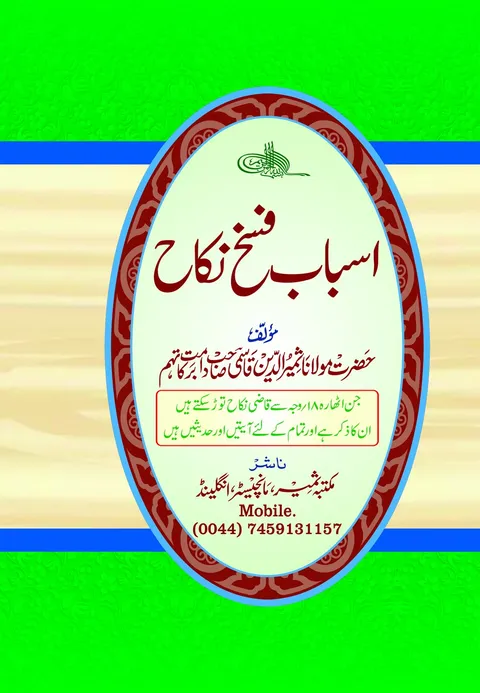
Asbab Faskh al-Nikah sets out the eighteen grounds on which a qadi may dissolve a marriage, each supported by a verse, a hadith or the saying of a Companion with its reference given in full. It closes on the position of a Muslim woman in Britain and Europe, where the court that separates her is not a Muslim one.
The book opens on the reason it was written. There was a time when a woman troubled by her husband went to a qadi, who heard her at once and got her right from the husband; the husband was afraid, and it did not come to the point where a life was ruined. That qadi is now nowhere to be found in time, and the woman is left in a house she cannot live in. On the other side, in Europe, a restraining order can keep a husband five hundred yards from his own house whether or not the fault was his, and prison follows if he crosses the line. Neither situation is the one the classical rulings were written for.
Asbab Faskh al-Nikah gathers the eighteen grounds on which a qadi may dissolve a marriage, drawn from al-Ḥīlat al-Nājiza and the Majmūʿa Qawānīn Islāmī: discord between the spouses; a husband who withholds what is her right; a husband who will not maintain her though he can, and a husband who cannot; severe beating; a husband missing and a husband merely absent; difference of abode; impotence; insanity; leprosy and the like; marriage below her kufʾ; a dower unduly cut; marriage obtained by deception; the option of puberty; separation for affinity; separation for a corrupted contract; and dissolution at the hands of a non-Muslim judge.
Every ground carries a verse, a hadith, a saying of a Companion or of a Successor, and every hadith and saying is referenced back to the book it comes from, so that the ground can be checked rather than taken on trust.
The last part of the book is about Britain and Europe directly: the six forms a separation granted by a non-Muslim court can take and what each one amounts to in the sharīʿah, and three questions the author says are worth thinking about: what a woman is to do when a judge has separated her, what to do when her heart will not accept it, and what road is left when three divorces have fallen at once.
Completed in Manchester on 11 February 2012, and published by Maktaba Thamir.