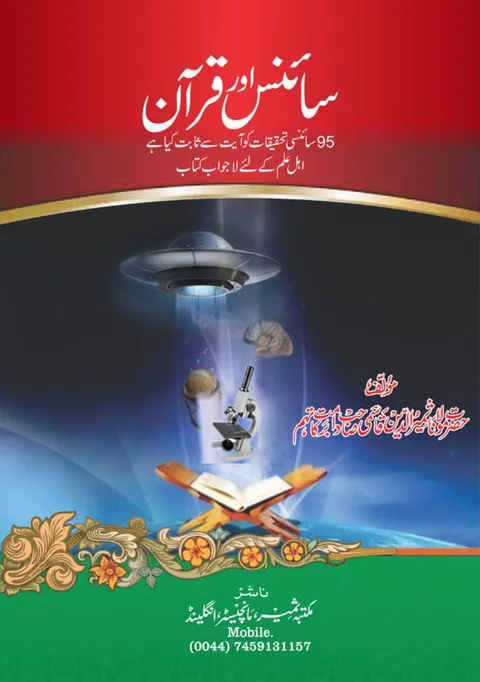
Science aur Quran is an Urdu book that sets ninety-five findings of modern science beside the verses of the Qur'an which bear on them. It argues from scripture alone, drawing on 124 verses and 14 hadiths, and prints a photograph for almost every finding it discusses.
Science aur Quran is two hundred and ninety-eight pages on a single question: where a finding of modern science and a verse of the Qur’an speak about the same thing, what does each of them actually say? The book gathers ninety-five such findings and puts the verses beside them.
The eight things it says about itself, printed on page five, are worth setting out because they are the plainest statement of what the book is trying to be. There are ninety-five scientific findings in it, and they are substantial ones that need reading with care. The argument is made only from verses and hadiths: one hundred and twenty-four of the first and fourteen of the second. It is meant to make the tafsir of those verses easier to follow. Placed in front of a non-Muslim, he says, these findings let a reader say that this is genuinely the book of God. An effort has been made to bring a scientific photograph for every finding. And it is written very simply.
The book moves outward from human history to the end of the world, in nine parts. It opens with the historical material, then the medical, which at eighty pages is much the longest section in the book, then animals, then the clouds of the atmosphere, then the mountains set on the earth, then how the earth itself is made, then the sky, and finally two sections on the signs near the Hour and the Hour itself.
It is a book of photographs as much as of text, which is why the file offered here is the full-resolution one: he exported it at three qualities, and the lower two either compress or shrink the images that carry half of what the book is saying.
Published by Maktaba Thamir, Manchester, first printing June 2019.