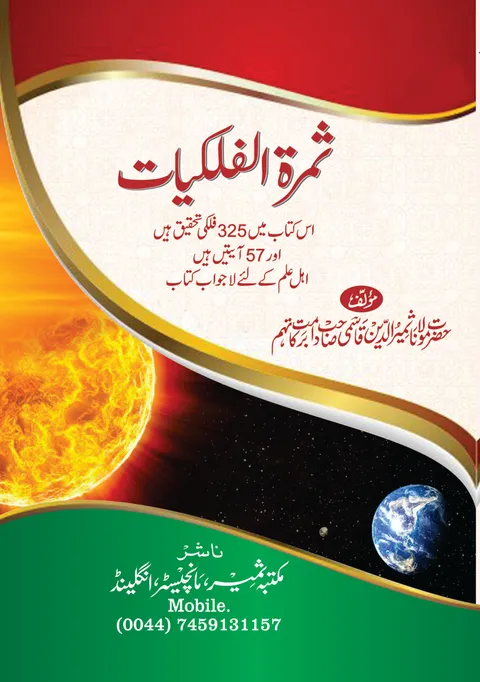
Thamarat al-Falakiyat is an Urdu book of modern astronomy in 325 findings, each set beside the Qur'anic verse or the hadith that bears on it. It covers the universe and the big bang, the earth, the moon, the sun and the nine planets, with an English name given for every heading so a reader can look it up.
Thamarat al-Falakiyat is his book on what the sky is now known to contain, written for students who have no way into the subject. Its own list of features opens with the count: 325 findings of the modern age, and 57 verses of the Qur’an brought to bear on them.
He first wrote it in 1995, under the name Falakiyat Jadida, out of the old Arabic books on the discipline and the World Book Encyclopedia. There was no internet then. Twenty-five years later he judged that enough had changed to be worth doing again, and rewrote it from the current research. The book says so plainly, and says equally plainly where the new material came from: the internet, and Wikipedia in particular. A reader is told what he is reading rather than left to assume.
The book runs through the state of the universe (the big bang, the age of about thirteen billion years, the galaxy and the Milky Way), then the earth in detail, its layers, its seas, its mountains, its cloud and its atmosphere; then the moon; then the sun, its age, its distance, the eight minutes and nineteen seconds its light takes to arrive, its volume, its orbital speed, the heat inside it and the corona outside; and then the nine planets, each under some twenty-two headings. Every heading carries its English name as well, so that anything in it can be followed up in the sources it came from.
Three things it does deliberately. Each finding is presented three times (as a table, then explained, then again) because the subject is unfamiliar and he wanted it understood and remembered rather than merely read. Photographs are used throughout, which is unusual in his books. And where a finding touches something the Qur’an or a hadith speaks of, the text is put beside it, so that a student knows which is which.
First published in May 2020 by Maktaba Thamir, Manchester.