
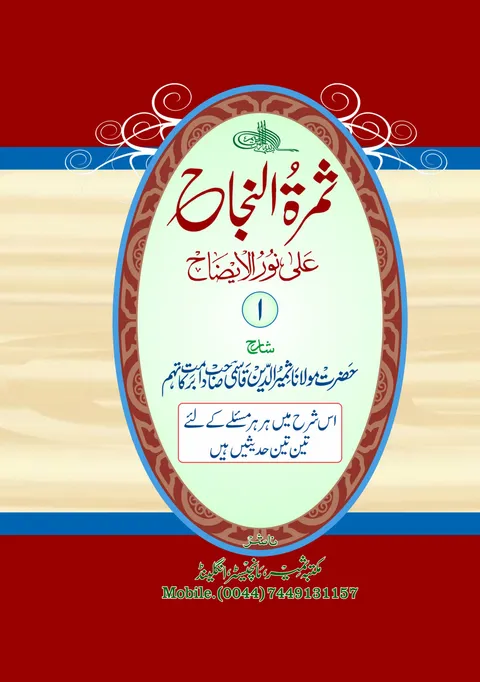
Thamarat un-Najah
ثمرات النجاح
ثمرة النجاح على نور الإيضاح
A two-volume Urdu commentary on al-Shurunbulali's Nur al-Idah, with three hadiths for every ruling
- Subject
- Fiqh
- Language
- Urdu
- Volumes
- 2
- Year
- 2010
A two-volume Urdu commentary on Hasan al-Shurunbulali's Nur al-Idah, the short Hanafi manual of worship. Every ruling is given three supporting hadiths with a full reference, and the obligations, necessities and sunnahs of each act are gathered into a single view so that they can be held in the memory.
Nur al-Idah, by Hasan ibn Ammar al-Shurunbulali (994-1069 AH), is the short Hanafi manual on purification, prayer, fasting, zakat and hajj that many students meet before anything longer. Thamarat un-Najah is a commentary on it in two volumes, built on the same method as the author’s commentaries on al-Quduri and al-Marghinani: in this commentary there are three hadiths for every single ruling.
The introduction lists what the commentary sets out to do.
- Three hadiths are brought for each ruling, each with its reference given in full.
- Every ruling is given an idiomatic, plain translation, written with students in mind.
- Each ruling is generally explained three times over, in different ways, so that both the ruling and its evidence are understood without effort.
- The obligations, the necessities and the sunnahs are presented together in a single view, which makes them far easier to commit to memory.
- Where a ruling turns on a principle of usul, the principle is named; difficult words are researched under a lughat heading.
- Sayings of the Prophet are marked hadith, of a Companion qawl sahabi, and of a Successor qawl tabi’i, so that the three are never taken for one another.
- Verbal disputes and rejoinders are deliberately left out.
- Old weights and measures are given alongside modern ones.
The introduction closes by saying the book is useful not only to students and their teachers but to imams and muftis, who need the evidence for a ruling at the moment they are asked for it.
First published in March 2010 by Maktaba Thamir, Manchester, printed in Delhi.