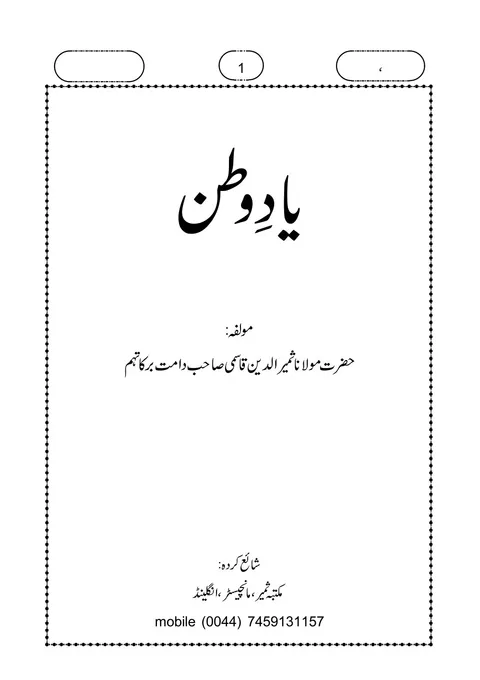
Yaad-e-Watan is an Urdu local history of the region the author was born in, around Khatti in the district of Godda. It gives the region's place and setting, then the lives of some forty of its scholars and of its English-educated notables, and opens with an account of the author himself.
Yaad-e-Watan is a hundred and six pages about one small place and the people it produced. It is the only book in this collection whose subject is not a science or a doctrine but a district.
It opens, unusually, with its own author. The author Mawlānā Samiruddin Ṣāḥeb, in the mirror of history, written by Sājid, gives the facts a biography starts from: he was born in the house of Janāb Jamāluddin Ṣāḥeb at Khaṭṭī, in the district of Godda, Bihar, on 26 Muḥarram 1370, which is 6 November 1950, and was brought up there until he was eleven. The piece is written by somebody who knew both father and son, and says so.
Then the book turns to the place itself, to what prompted Yaad-e-Watan and where this region actually lies, before beginning the work it exists for. Something like forty lives follow. The scholars come first, each with the village that names him: the murshid Mawlānā Sayyid Shamsuddin of Lucknow, Ḥāfiẓ Sayyid Ṣafdar Ḥusain of Hirwāḍiya, Mawlānā Ramżān ʿAlī and Mawlānā Kawthar ʿAlī of Gorgāwān, Mawlānā Liyāqat Ḥusain of Deokunḍā, Mawlānā Aṣghar Ḥusain of Shāhpur, Mawlānā Khalīlur Raḥmān of Sharrī Chak, Mawlānā Anwar ʿAlī of Kaithiyā, Mawlānā Munīruddin, Muftī Salāmatullāh of Nayāgarhī, and others.
A second list follows them under its own heading, the accomplished among the English-educated: schoolmasters, an engineer, professors, a principal. That the two lists sit in one book, and that the second is given the same care as the first, is the book’s own quiet argument about what a place is worth remembering for.
Published by Maktaba Thamir, Manchester, in 2020, corresponding to 1441 AH. Composed and set by Muhammad Jahāngīr at the Delight Computer Centre, Deoband.