
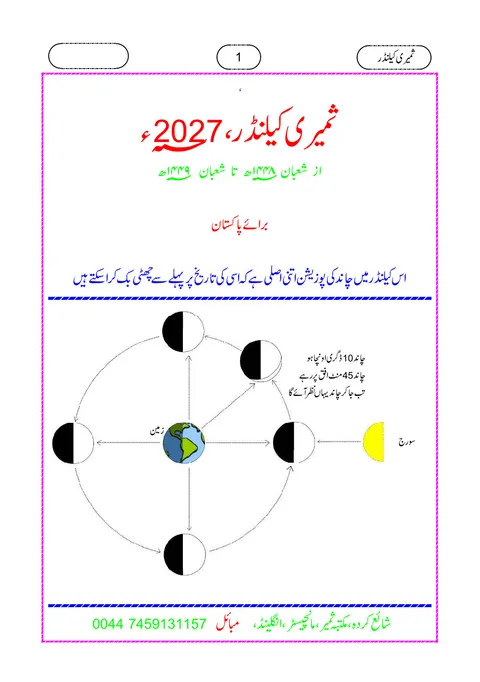
The Thamiri Calendar 2027 for Pakistan gives the year from Shaban 1448 to Shaban 1449, one page for each month, with the day every Hijri month begins worked from a moon ten degrees high. Each month carries a world map of where the new crescent can be seen, and a summary page sets the year's festivals in Pakistan beside the Saudi dates.
A calendar for one year, 2027, made so that families in Pakistan can book their holidays in advance. Its title page says so in as many words: the moon’s position in it is accurate enough to book leave on its dates. It runs from Shaʿbān 1448 to Shaʿbān 1449 and gives one page to each month of the Gregorian year.
The rule it rests on is drawn on that title page: the moon has to stand ten degrees above the horizon and stay forty-five minutes above it before it can be seen. Each month’s page gives the day the Hijri month begins, and for the evening before and the evening of the sighting the moon’s altitude, the minutes it stays above the horizon, its age and the time of the new moon in Pakistan time. Below that is the month laid out day by day with both dates. Above it is a map of the whole world showing where the new crescent can and cannot be seen, with the moon’s altitude and age in twelve cities, Karachi among them, prepared by Hafiz Engineer Muhammad Tahir under the scholar’s supervision.
The second page sets out the year’s festivals in Pakistan and in Saudi Arabia, with the day:
- Shab-e-Barat from the evening of Saturday 23 January (Saudi Arabia: Friday 22 January)
- Ramadan on Tuesday 9 February (Saudi Arabia: Monday 8 February)
- Eid al-Fitr on Wednesday 10 March (Saudi Arabia: Tuesday 9 March)
- Eid al-Adha on Monday 17 May (Saudi Arabia: Sunday 16 May)
- The tenth of Muharram on Tuesday 15 June, the same day as in Saudi Arabia
Like all his calendars, it says plainly what it is not. The moon is seen once it is more than nineteen hours old and ten degrees high; at nine degrees it is found first with binoculars and then, with difficulty, by eye. The calculation is only a guide, and acts of worship begin once the moon has been seen.
The same year is worked for India and for England. Fifteen years at once are in the Pandra Sala Calendar, and the moon’s figures for a single place up to 2100 are on Moon Positions.
Published by Maktaba Thamir, Manchester, England.