
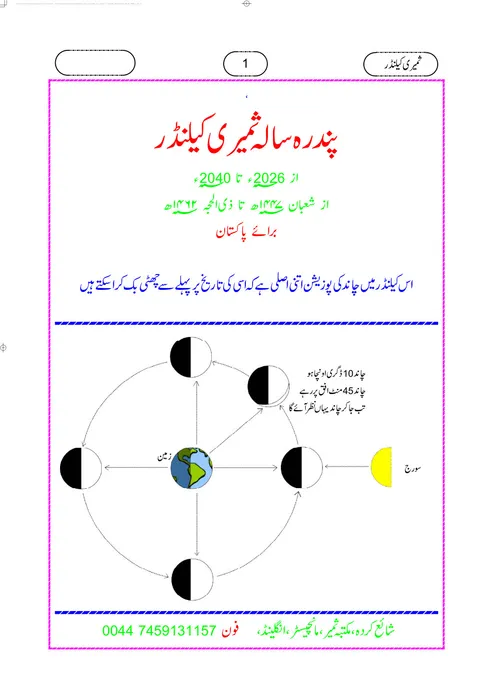
The Pandra Sala Calendar for Pakistan gives fifteen Hijri years, Shaban 1447 to Dhu al-Hijjah 1462, against the Gregorian years 2026 to 2040. Every month is worked from the moon's altitude at Karachi, and the Saudi dates are printed beside the Pakistani ones.
The Pakistan edition of the fifteen-year calendar: Shaʿbān 1447 to Dhū al-Ḥijjah 1462, against 2026 to 2040. It is the same work as the Indian one, done again on a different horizon, and the horizon is the whole point: a calendar computed for one country does not transfer to the next.
Each month is worked from the tables of the H.M. Nautical Almanac Office, for the
latitude and longitude of Karachi: the moon’s altitude, the minutes it stays above the
horizon, its age, and the time of the new moon. The rule is the one printed on the first
page: ten degrees high and forty-five minutes above the horizon before the moon will be
seen. Beside each month is that month’s timeanddate calendar and the world visibility map
from moonsighting.com. The Saudi dates run beside the Pakistani ones throughout, so that
hajj can be planned from the same page, and the front of the book carries the fifteen years
of Ramaḍān, ʿĪd al-Fiṭr, Baqr-ʿĪd, the tenth of Muḥarram and Shab-e-Barāt with their
weekdays.
He states plainly in the book’s own list of features that the calendar is a guide, and that acts of worship follow the sighting of the moon. What calculation settles is that a claimed sighting was impossible; it does not begin a month by itself.
The same fifteen years are worked for India and for England, and the astronomy behind all three is set out in Thamarat al-Falakiyat.
First published in January 2026 by Maktaba Thamir, Manchester.