
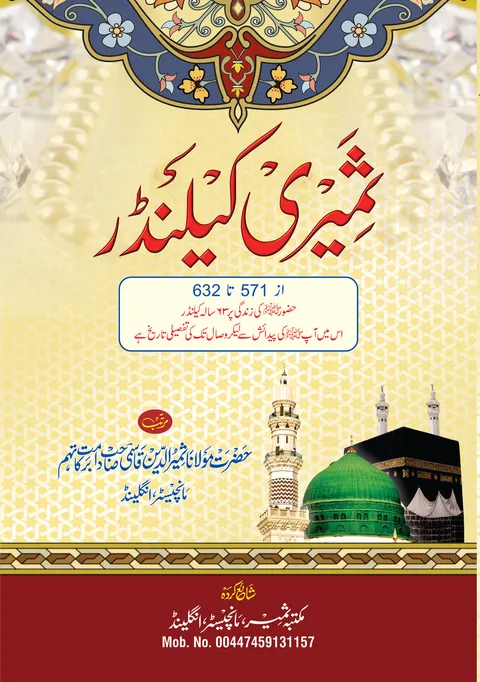
The Thamiri Calendar is a 63-year calendar of the life of the Prophet, from his birth in 571 CE to his passing in 632. Every date carries a hadith or an early sirat reference, and the Gregorian day is worked from astronomical tables alongside the Hijri one.
Students asked him for a calendar of the Prophet’s life ﷺ that would be sound by the Gregorian reckoning and sound by the Arabic one at the same time, that would cite its sources, and that would give the day as well as the date. The Thamiri Calendar is that, and it runs from 571 CE to 632 CE.
The two halves of the work are done differently, and he says so. The Gregorian day and date,
and the time of each new moon, are taken from the tables of timeanddate; for every month
the calendar itself is reproduced, and beside it the new moon’s time, the moon’s age, how
many minutes it stays above the horizon and how many degrees high it stands. For the Arabic
date he prefers a hadith wherever one fixes it; where none does he goes to the sirat writers
before the third century (Ibn Ishaq, who died in 151 AH, Ibn Hisham in 213, al-Waqidi in
207), and below them only when those are silent. Where the reports disagree he gives the
hadith preference, and then works to bring the Arabic date and the Gregorian one as close
together as they will come.
It says what it does not know. The dates in it are approximate, and the book states in its own list of features that only the date of the Farewell Pilgrimage is certain, because a hadith settles that one. Nothing particular is recorded of the forty years between the birth and the prophethood, so those years are given briefly: the first of Muharram of each, and the year in which Sirat Halabiyya places an event. The birth year is set out in full, and so is every year from the prophethood to the passing, each event with its reference and its weekday.
At the end are the dates of the marriages to the Azwaj-e-Mutahharat and the dates of the major battles, each with the source it was taken from, so that a single date can be found without reading through the years to reach it.
The astronomy this rests on is his own subject, and is set out at length in Thamarat al-Falakiyat.
First published in March 2023 by Maktaba Thamir, Manchester.