
Al-Quduri maa Ahadithihi
القدوری مع احادیثہ
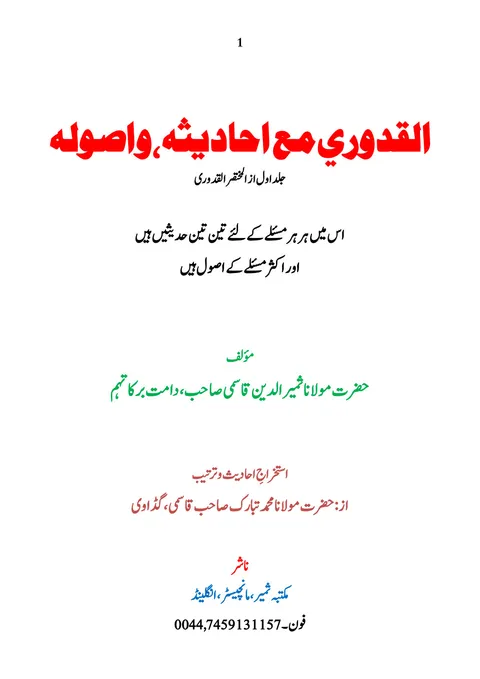
القدوري مع احاديثه وأصوله
The text of al-Quduri's Mukhtasar in two volumes, with three hadiths and the governing principle set beneath every ruling
- Subject
- Fiqh
- Language
- Arabic
- Volumes
- 2
- Year
- 2025
Al-Quduri maa Ahadithihi sets three hadiths and the principle behind them beneath every ruling of al-Quduri's Mukhtasar, in two volumes. The matn is fully vowelled; the hadiths come from thirteen of the earliest collections, each referenced to book, chapter and number and marked as a hadith, a saying of a Companion or a saying of a Successor. The principles and the glossary are in Urdu. This is the book Mawlana Ashraf Ali Thanwi asked for in 1943, and the first hadith set the Mukhtasar has ever carried.
The Mukhtasar of Abu’l-Husayn al-Quduri is the first book of Hanafi fiqh a student meets, and it is terse by design: it states the ruling and cites nothing. That is exactly what makes it the book most often held up as proof that the school runs on opinion rather than on evidence.
This is the first hadith set the Mukhtasar has ever carried, and it is the second half of an errand set eighty years ago. In 1943 Mawlana Ashraf Ali Thanwi asked for every Hanafi ruling to be given its hadith, because no Hanafi book had one; Mawlana Zafar Ahmad Uthmani answered with I’la al-Sunan, working mainly on al-Hidayah. The Mukhtasar was left. Here three hadiths stand under every ruling in it, and the author writes plainly what that settles: now no one will be able to say that the Hanafis have no hadiths and act on analogy.
Two things are new since I’la al-Sunan, and both are printed books that were then manuscripts. Musannaf Ibn Abi Shaybah and Musannaf Abd al-Razzaq, twelve volumes each, hold the sayings of the Companions and the Successors on which the school’s finer rulings actually rest, and they are al-Bukhari’s own sources, so a Shafi’i, a Maliki or an Ahl-i Hadith reader takes evidence from them too.
The matn is fully vowelled. Every ruling is marked as resting on a verse, a hadith, a saying of a Companion or a saying of a Successor, and the author gives the reason that matters for a student: with the evidence in front of you, the degree of the ruling can be settled. A hadith behind it makes it sunnah, a saying of a Companion makes it recommended, where before one applied the ruling without knowing which it was. Difficult words are glossed, and the principle is stated in Urdu beneath the ruling.
The extraction and arrangement of the hadiths and the writing of the principles are the work of Mufti Muhammad Tabarak Qasmi of Godda, Jharkhand: two volumes in eight months, drawing on Thamarat un-Najah. Endorsed by Mufti Abu’l-Qasim Nomani, rector and Shaykh al-Hadith of Darul Uloom Deoband, on 26 October 2025, who notes that the author had already done the same for al-Hidayah at greater length.
Published June 2025 by Maktaba Thamir, Manchester. The author’s own Urdu commentary on the same Mukhtasar is Al-Sharh al-Thamiri; the same method applied to al-Hidayah is Al-Hidayah maa Ahadithiha.