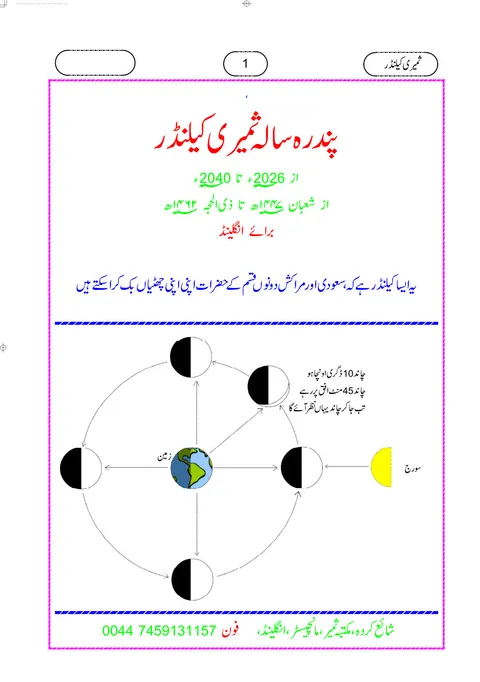
The Pandra Sala Calendar for England gives fifteen Hijri years, Shaban 1447 to Dhu al-Hijjah 1462, against the Gregorian years 2026 to 2040. It is computed for London at a nine-degree moon, and carries both the Saudi and the Marrakesh dates, because British mosques follow one or the other.
The English edition of the fifteen-year calendar, Shaʿbān 1447 to Dhū al-Ḥijjah 1462 against 2026 to 2040, and it is the one of the three that had to be built differently. He has lived in Manchester for decades and the difficulty it answers is a British one: the mosques here do not follow a single horizon. Some take their dates from Saudi Arabia and some from Morocco, so this calendar prints both, and says at the top that it is made so that people of either kind can book their own holidays.
Two things separate it from the Indian and Pakistani volumes. The threshold is nine
degrees rather than ten, and the month begins wherever the moon first reaches nine degrees
among England, Marrakesh and Africa, three horizons taken together rather than one. The
detail for each month is computed for the latitude and longitude of London: the new
moon’s time, the moon’s age, the minutes it stays above the horizon and the degrees it
stands at, all from the tables of the H.M. Nautical Almanac Office, from which the Saudi
dates are also taken. Each month carries its timeanddate calendar and the world visibility
map from moonsighting.com.
As in the other two, the book states in its own list of features that it is a guide and that acts of worship follow the sighting of the moon.
The same fifteen years are worked for India and for Pakistan. Praying in a country this far from the equator raises a second problem, which is the subject of Subh-e-Sadiq.
First published in January 2026 by Maktaba Thamir, Manchester.