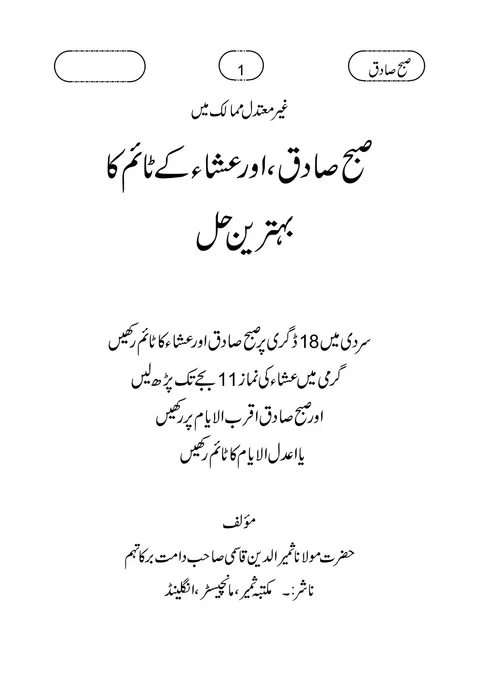
Subh-e-Sadiq is a short Urdu treatise on the times of true dawn and Isha in countries where the summer night is too short for either to fall at a workable hour. It sets out what the eighteen-degree tables actually say, and the two established ways of holding a time, aqrab al-ayyam and adal al-ayyam.
Britain is not a temperate country, and the treatise opens by saying what that costs. Here the day runs to sixteen and a half hours and the night to seven and a half, and then the other way round. In high summer the twelve-degree ʿishāʾ falls at half past twelve at night and true dawn at a quarter past one in the morning, so that praying ʿishāʾ at its own time is extremely hard and rising for saḥrī an hour later is beyond most people. Subh-e-Sadiq is thirty-two pages on what to do about it.
His answer has two halves. For the months in which eighteen degrees can be acted on without hardship, act on eighteen degrees: the tables are what they are, and he prints the photographs to show that dawn at that latitude is at eighteen and not before. For the summer months, from the clock change at the end of March, come down a minute or two a day, give the adhān at a quarter to eleven and pray ʿishāʾ by eleven, and not later than that. All of it, he says, is to be built on the ground of genuine ḥaraj.
For dawn he sets out the two ways of holding a time. On aʿdal al-ayyām the formula is applied from the end of March downward. On aqrab al-ayyām the last true dawn is held: in London that is a quarter past one on 22 May, so saḥrī is taken before a quarter past one and fajr prayed after it, and that stands until 21 July. Either can be acted on; he sets out both rather than choosing for the reader.
The astronomy is worked from the time tables of the H.M. Nautical Almanac Office, into which a city’s own longitude and latitude are entered, and from photographs he took from Google Images. He gives the office’s address at the end so that anyone can ask it for their own town.
He ends by saying what the book is not. “I am not a mufti, so I cannot give a fatwa. These are things found astronomically, presented here, with the hadiths that suit them brought alongside. Ask the muftis. And if you think it right, let the mosque decide it together.” Signed in Manchester on 25 August 2021.
The moon side of the same problem is Ittihad-e-Matla, and the prayer times of the fifteen years ahead are in the calendar for England.
Published by Maktaba Thamir, Manchester.