
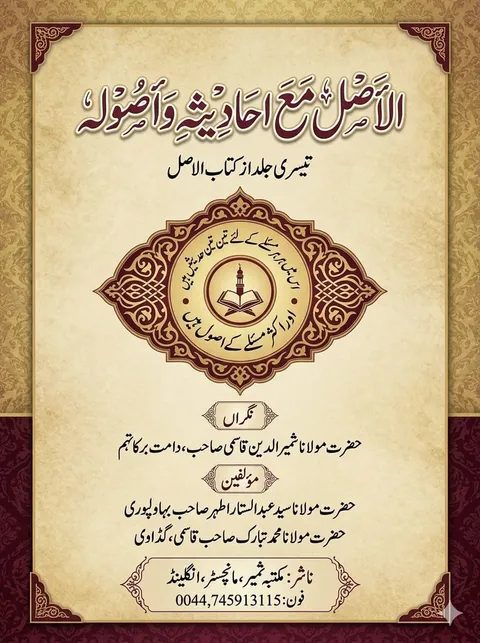
Al-Asl maa Ahadithihi
الاصل مع احادیثہ
الأصل مع أحاديثه وأصوله
The text of Imam Muhammad's al-Asl, with three hadiths and the governing principle set beneath every ruling
- Subject
- Fiqh
- Language
- Arabic
- Volumes
- 4
- Year
- 2026 (1447 AH)
VolumesWhich volume to download?Which volume to share?4
- 1Volume 1پہلی جلدKitab al-Salah, from the opening to Bab al-Dua fi'l-Salah.ReadDownload
- 2Volume 2دوسری جلدKitab al-Salah continued, Bab Salat al-Marid to Bab al-Salah bi-Makkah.ReadDownload
- 3Volume 3تیسری جلدKitab al-Hayd, Kitab al-Zakah, and Kitab Masarif al-Khums wa'l-Ushr.ReadDownload
- 4Volume 4چوتھی جلدKitab al-Sawm with its Nawadir, Kitab al-Taharri, Kitab al-Istihsan and Kitab al-Ayman.ReadDownload
Al-Asl maa Ahadithihi sets three hadiths and the principle behind them beneath every ruling of Kitab al-Asl, the earliest and most foundational book of Hanafi jurisprudence. Four volumes are finished, covering prayer, menstruation, zakah, fasting, istihsan and oaths, out of a work planned to run to about thirty-six. Every ruling is marked as resting on a verse, a hadith, a saying of a Companion or a saying of a Successor, with a full reference. Endorsed by Mufti Abu'l-Qasim Nomani, rector of Darul Uloom Deoband.
Kitab al-Asl is where Hanafi fiqh begins. Among the books of zahir al-riwayah it holds the foundational place, because in it Abu Sulayman al-Juzjani transmits the rulings directly from Imam Muhammad ibn al-Hasan al-Shaybani, who had them from Abu Hanifah. It is also, as Imam Muhammad’s own opening line concedes, a book of rulings and nothing else: I have set out for you the position of Abu Hanifah, and of Abu Yusuf, and my own. No evidence is cited anywhere in it.
This is the hadith set for it, and it is the largest of the four the author has undertaken. Four volumes are finished against twelve volumes of matn, and the completed work is expected to run to about thirty-six. The first two cover Kitab al-Salah alone. The third, printed in August 2026, covers Kitab al-Hayd, Kitab al-Zakah and the disbursement of the khums and the tithe. The fourth, printed in September 2026, covers Kitab al-Sawm with its nawadir, Kitab al-Taharri, Kitab al-Istihsan and Kitab al-Ayman. The site carries the four that exist and will carry the rest as they are printed.
The title essay states the case in one line: now nobody will call Imam Abu Hanifah one of the Ashab al-Ra’y. The author’s argument is historical. The charge that the school runs on opinion is as old as the school, and it stuck for a reason: not one Hanafi book set the hadiths beside the rulings: not al-Asl, not al-Mabsut, not al-Jami’ al-Saghir or al-Kabir, not al-Hidayah, al-Quduri, Nur al-Idah, al-Durr al-Mukhtar, Qadi Khan or Kanz al-Daqa’iq. In an age when every reader asks for the evidence of a ruling, leaving it elsewhere is no longer possible. Put three hadiths under every ruling of al-Asl, drawn from the same thirteen early collections the other side draws on, and the charge has nowhere left to stand.
Eight things follow, and they are the same eight as the other three volumes of this series: a fully vowelled matn; a verse, hadith, saying of a Companion or saying of a Successor for every ruling; a plain statement of which of the four it is; thirteen early collections and no more; no argument from the words of later scholars, however weighty; the governing principle stated for most of the text; a glossary of difficult words; and a book set simply enough to be taught from.
How the work is credited on its own title page. Mawlana Samiruddin Qasmi is named as its supervisor, nigran, and the compilers are Mawlana Sayyid Abd al-Sattar Athar Bahawalpuri and Mawlana Muhammad Tabarak Qasmi of Godda, Jharkhand. Writing his endorsement on 7 Shawwal 1447, Mufti Abu’l-Qasim Nomani, rector and Shaykh al-Hadith of Darul Uloom Deoband, describes the book as the fruit of Mawlana Samiruddin Qasmi’s research effort on al-Asl, and notes that alongside the six canonical collections the hadiths are drawn from Musannaf Ibn Abi Shaybah, Musannaf Abd al-Razzaq, Musnad Ahmad and al-Tabarani.
Published by Maktaba Thamir, Manchester. The matn on its own, vowelled and set in twelve volumes, is Kitab al-Asl. The same method applied to the three later matns is Al-Hidayah maa Ahadithiha, Al-Quduri maa Ahadithihi and Nur al-Idah maa Ahadithihi.