
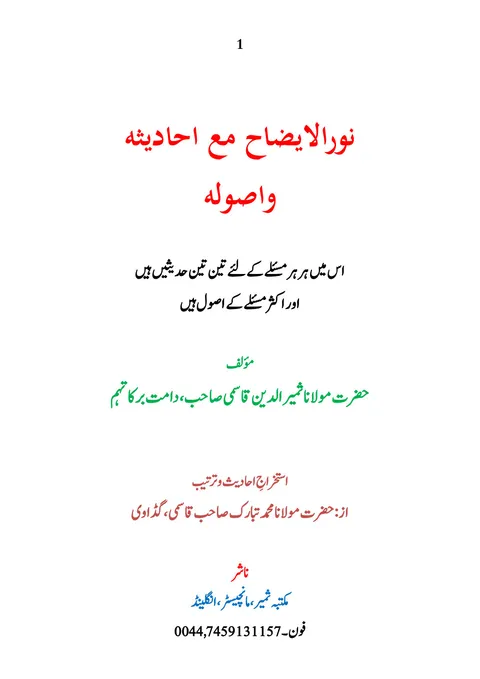
Nur al-Idah maa Ahadithihi sets three hadiths and the principle behind them beneath every ruling of al-Shurunbulali's Nur al-Idah, the beginner's book of Hanafi worship. The matn is fully vowelled; the hadiths come from twelve of the earliest collections, each referenced to book, chapter and number and marked as a hadith, a saying of a Companion or a saying of a Successor. The principles and the glossary of difficult words are in Urdu. The third and shortest of the author's four hadith sets on the Hanafi matns.
Nur al-Idah is where a beginner starts: purification, prayer, fasting, zakah and hajj, and nothing beyond them. It is short, and like every Hanafi matn it states its rulings without citing evidence for any of them.
This puts three hadiths under each one. It is the third of four books applying the same method to the four matns a student passes through: al-Hidayah first, then al-Quduri, then this, and Imam Muhammad’s own al-Asl. The errand behind all four is Mawlana Ashraf Ali Thanwi’s request of 1943, that every Hanafi ruling be given the hadith it rests on, because at that time no Hanafi book carried one.
The book’s own list of what it does runs to eight points. The matn of Nur al-Idah is given fully vowelled, so it reads easily. Every ruling has a verse, a hadith, a saying of a Companion or a saying of a Successor beneath it, and which of the four it is, is stated, so that the strength of the ruling is visible. The hadiths are taken from twelve collections only, all of them early, one fewer than the thirteen used for al-Hidayah and al-Quduri, this being a shorter book. The words of later scholars, however weighty, are deliberately not used as evidence. Most rulings carry their governing principle in Urdu. Difficult words are glossed. And the whole is set to be taught from.
The extraction and arrangement of the hadiths and the writing of the principles are again the work of Mufti Muhammad Tabarak Qasmi of Godda, Jharkhand, this time in four months, drawing on Thamarat un-Najah, the author’s own Urdu commentary on this same matn.
Published January 2026 by Maktaba Thamir, Manchester. The first volume’s two endorsement pages are headed and left blank, so the book carries none. The companion volumes are Al-Hidayah maa Ahadithiha, Al-Quduri maa Ahadithihi and Al-Asl maa Ahadithihi.