
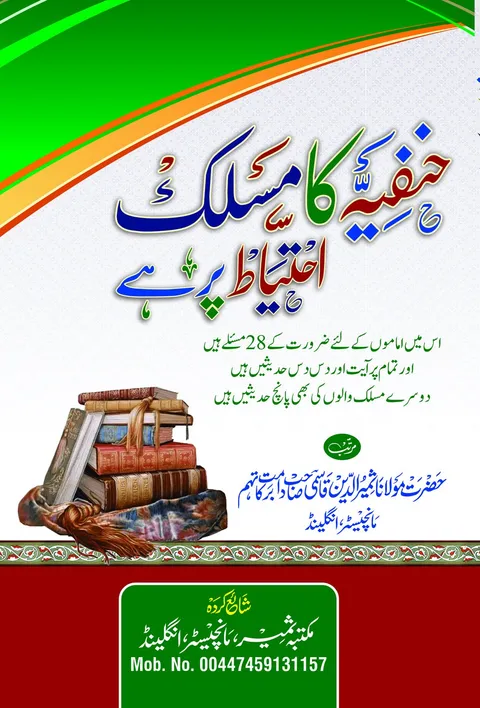
Hanafiyya ka Maslak Ihtiyat par Hai takes thirty questions an imam is asked week after week and sets out, for each one, the verses and the hadiths on both sides. Where the Ahl-e-Hadith cite five hadiths it brings seven for the Hanafi position, and every reference comes from twelve primary collections only.
Hanafiyya ka Maslak Ihtiyat par Hai, the Hanafi position rests on caution, is a book for the imam of a mosque rather than for the seminary. It takes thirty questions that come up in the prayer hall week after week, from raising the hands in prayer to whether the reward of a recitation reaches the dead, and for each one it prints the verses and the hadiths of both sides one after the other.
The argument of the title essay is a single one, and he puts it plainly at the start. Following the Hanafi position means acting on all the hadiths at once, and on the verse as well. Where the hands are not raised repeatedly, wa qūmū lillāhi qānitīn (al-Baqarah 2:238) is acted upon and so are the many hadiths that do not raise them, whereas raising them cannot fully act on the verse. Where Fātiḥa is not recited behind the imam, 7:204 is acted upon along with the hadiths and the sayings of the Companions that say the same. Where āmīn is said quietly, 7:55 is acted upon together with the hadith of saying it quietly. That is what he means by caution: the position that leaves the fewest texts unacted upon.
He set eight rules for himself and prints them at the front of the book:
- Only a verse, a hadith, or the word of a Companion or a Successor is used as proof. The statements of later scholars are left out, so that the book does not grow long.
- Each one is marked as what it is: verse, hadith, Companion, Successor.
- Everything is referenced from twelve primary books and no others.
- The hadiths of both the Hanafi position and the other are given.
- Where the Ahl-e-Hadith bring five hadiths, seven are brought for the Hanafis; where they bring seven, ten are brought.
- Both sides are gathered so that each has the other’s hadith in front of it and the disagreement narrows.
- The book is meant to be easy, and small enough to keep on a phone.
- Where the word hadith has been used for what is in fact the word of a Companion or a Successor, he asks the reader’s pardon for it.
The apparatus behind it is his own earlier work. Athmar al-Hidayah and al-Sharh al-Thamiri supply hadiths for every ruling of al-Hidayah and al-Quduri, and this book is the short answer drawn out of them: not that the Hanafis reason where others report, but that the reports exist and are rarely set side by side anywhere an imam can reach them.
Published by Maktaba Sameer, Manchester. The book has been translated four times, and each translation is on this site as its own edition:
- Arabic, translated by Dr Mufti Muhammadullah al-Khalili and Mufti Abu al-Farah al-Qasimi.
- English, translated by Dr Mufti Muhammadullah Khalili Qasmi.
- Bengali, translated by Enamul Haque Masud.
- Persian, translated by Muhammad Ibrahim Taymuri.
The Arabic, English and Bengali editions carry twenty-eight of these questions, which is what their own title pages state. This Urdu edition and the Persian carry thirty.